Welp, we tried Pinterest for our podcast, M.O.M. Files – Moments of Motherhood, and here’s how it went.
I wanted to run a little 3-month experiment to see how well Pinterest could help market our show.
Our goal was to keep growing the podcast even while we were on hiatus. And since we started with a pretty small Pinterest account (around 50 followers), I thought this would be a good opportunity to test what Pinterest could realistically do for a podcast and account at our size.
We did gain followers, and some of our Pinterest stats improved. But did those people actually become podcast listeners?
That was the real question. So, let’s get into what I tested, what the numbers showed, and what I’d do differently next time.
The setup
I ran this experiment from July through September 2026.
Since we were on hiatus and weren't publishing new episodes, I promoted a different season of the podcast each month rather than creating new content.
I focused on our top-performing episodes, with one main goal: get people to click through and actually listen to an episode.
To test what type of Pin worked best, I created two formats:
Pin A: Static quote graphic featuring a quote from the episode
Pin B: Tip carousel sharing useful takeaways from the episode
The structure and messaging were similar for both formats. Each episode received one of each Pin, and I posted them weekly throughout the experiment.
At the end of each month, I reviewed the stats to see what was working, what wasn't, and whether Pinterest was bringing us closer to our goal.
The Month-by-month results
So, here is what our stats looked like each month -
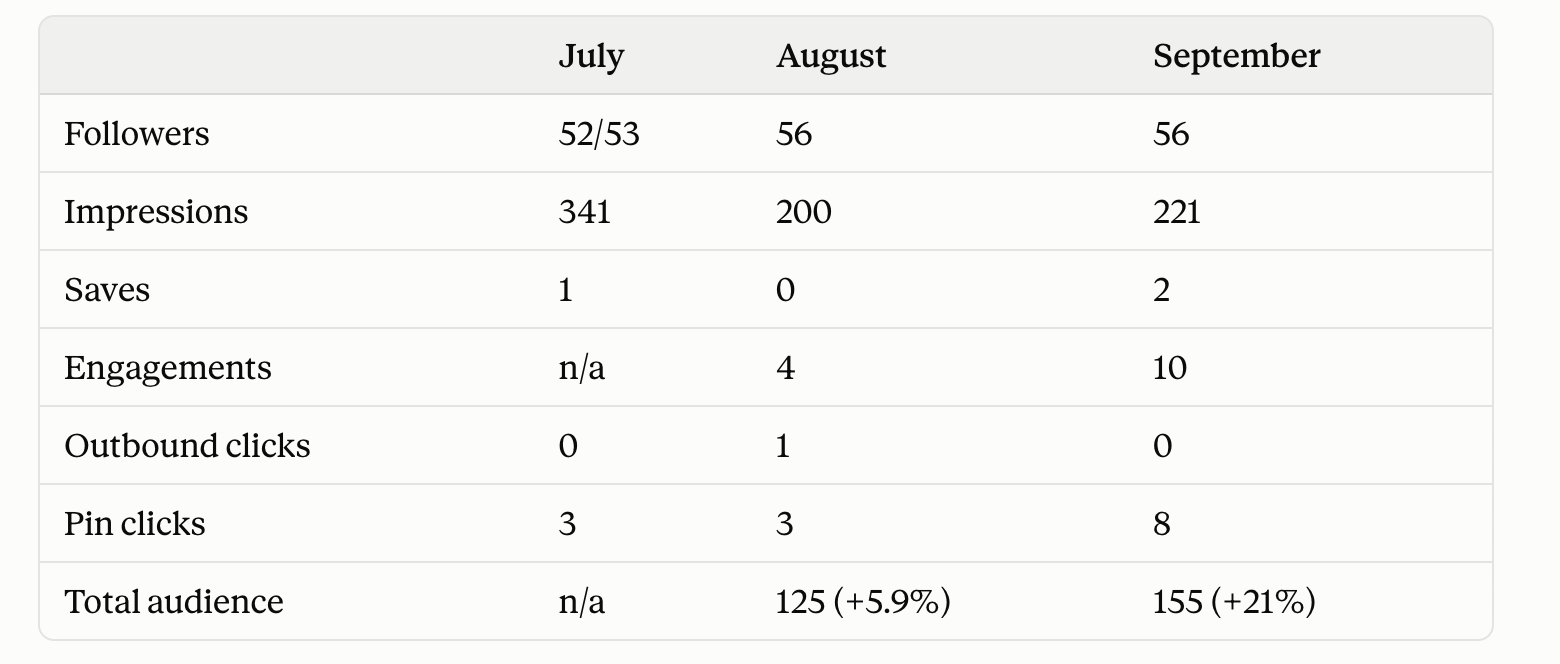
Looking at the numbers, we saw some growth. Our audience grew, and our Pin clicks increased. But at the same time, impressions dropped.
So, while some of the numbers were moving in the right direction, the results weren't quite as straightforward as I'd hoped.
July
In July, I began publishing the content and adding new Pins to Pinterest. We saw some Pin clicks, but no outbound clicks to our podcast episode pages. And since getting people to the actual episodes was the goal, that wasn't exactly the result I was looking for.
Still, it gave us a starting point to compare against the next two months.
August
In month 2, I decided to switch up the posting days to Mondays and Tuesdays (worked with my schedule). Impressions dipped, but our audience continued to grow. We also got our first outbound click!
But was all the time spent creating and scheduling content worth it for that one click? That was harder to answer.
September
And finally, the last month brought our highest engagement and Pin clicks of the three months, along with continued audience growth.
We also saw a slight improvement in outbound clicks. That was encouraging, but it still wasn't enough to say Pinterest had become a reliable source of traffic for our podcast.
One thing I did notice throughout the experiment was that consistency seemed to help some of our numbers improve. Pinterest may take time to build momentum, so I wouldn't expect results overnight.
That said, consistency alone doesn't guarantee conversions. And for us, getting people to actually listen was the most important part.
What the numbers actually say
After three months, here's what I took away from the data.
1. Our Pinterest audience was growing.
We gained followers and saw improvements in some engagement metrics. So, even though the account was small, we were making some progress in building our presence.
2. Pinterest wasn't a strong traffic driver for our podcast at this scale.
Our outbound clicks stayed between zero and one per month throughout the experiment. That meant Pinterest wasn't consistently sending people to our podcast episode pages, which was the main goal I was trying to accomplish.
3. Consistency seemed more useful than changing the Pin format.
We tested two different formats, but neither clearly outperformed the other. Posting consistently seemed more worthwhile than spending extra time trying to create a more time-consuming pin.
And that brings me to the next question: Did the static quote graphics or tip carousels perform better?
The A/B result of the Pins
I wanted to find out three things:
Which format performed better for saves, Pin clicks, and outbound clicks?
Did one format consistently win across all three seasons, or was a result driven by a single episode?
Did the episode topic matter as much as the Pin format?
After three months, our static quote Pins earned 49 impressions, while the carousels earned 47.
So, essentially, it was a tie.
With numbers that small, I can't confidently say one format performed better. It seems Pinterest showed both formats to roughly the same number of people, and the carousels didn't appear to give us any meaningful boost in reach.
For an account our size, I wouldn't spend extra time creating carousels when a simple pin seems to do just as well.
If I continue with this strategy, I'd stick with quote graphics for now. They're quicker to create, and the carousels didn't show enough of an advantage to justify the extra work (or time spent).
As for the other questions, I didn't see a clear winner across the formats or enough evidence to say that one episode topic consistently performed better. The sample was too small to draw any big conclusions.
If I were to test this again, I'd focus less on the format itself and more on the specifics of the Pin: the headline, the quote, and the call to action.
Could a more compelling headline get someone to click? Would a different CTA encourage more people to listen? Those are the things I'd want to test next.
One thing to keep in mind when looking at the stats: we had other Pins on Pinterest outside this experiment, and some of the overall impressions may have come from those.
That's actually one of the things I like about Pinterest. Content can continue getting traction months, or even a year, after you publish it.
The Tracking Mistake I Wish I'd Avoided
This is probably the biggest thing I'd change if I ran the experiment again.
I didn't set up a strong enough tracking system to follow the entire journey from Pinterest to an actual podcast play.
Ideally, I wanted to track:
Pinterest Pin → podcast episode page → to an actual listen
I could see that people were clicking through to the website, but I struggled to determine whether those clicks turned into actual episode plays.
I should have set up better tracking links from the beginning, such as unique UTM-tagged URLs for each Pin, along with analytics that could help me connect website visits to listening activity. Especially because our hosting doesn’t have that detailed of stats (yours might though!)
That way, I could have compared the two Pin formats more accurately and had a better idea of whether Pinterest was bringing us listeners.
We did receive 80 podcast downloads during the three-month experiment, and we weren't actively promoting the podcast elsewhere during that time. It's possible some of those downloads came from Pinterest.
But without proper attribution, I can't confidently say how many, if any, were directly driven by Pinterest.
And that's an important distinction: downloads during the experiment don't automatically mean Pinterest caused those downloads.
If your goal is to grow your podcast audience, tracking clicks is useful. But tracking whether those clicks lead to listens would be even better.
Lessons learned
Was Pinterest worth it? Honestly, yes and no.
What worked
We gained followers and continued building our Pinterest presence.
Some engagement metrics and Pin clicks improved over time.
We learned that static quote graphics could perform similarly to carousels with less work.
We tested a new marketing channel while the podcast was on hiatus.
What I'd do differently
Set up tracking links before publishing anything.
Track the full journey from Pin click to episode page to listen, where the available analytics allow.
Spend less time creating complicated graphics when a simpler format performs similarly.
Give the experiment enough time, but set clear goals for what success actually looks like.
Ultimately, Pinterest helped us build our presence, but I don't feel like I fully accomplished my main goal of driving more podcast listens.
So, was it worth the effort? I'm glad we tested it, but if I didn’t have the time, I would put a hold on it.
Is Pinterest Worth It for Your Podcast?
I'd say it's worth experimenting with if your audience is on Pinterest, you have some time to test it, and you can create content without adding a ton of work to your schedule.
Our audience is on Pinterest, which is why I wanted to give it a try in the first place.
But if your audience isn't using the platform, or if creating Pins takes time away from marketing channels that are already working for you, you don't need to force it.
You don't have to be everywhere. You need to figure out where your audience is and what actually helps you reach your goals.
What's next
I do think we will keep Pinterest in the marketing mix, but we’ll make sure that it’s simple (just a quote graphic) and not a time-consuming process (say 30 minutes a month to prep and schedule).
As well as add a better tracking link, and then I would see how it did for another 3 months.
If it started really plummeting, I would probably put a pause on posting there.
Let me know in the comments if you have used Pinterest for your podcast marketing and if you had any luck? Let me know in the comments!
Aleea